Showing posts with label nonfiction. Show all posts

Wednesday, March 21, 2007

Happy Cruelty Day!: Daily Celebrations of Quiet Desperation

By Bob Powers
Thomas Dunne Books
2006

Sometimes, we need things to celebrate. Sometimes, we need things to do. Sometimes, we need a specific day to lie to our cats about the crucifixion of Jesus (it's February 15th, just in case you were curious). For all of these things, I highly recommend this book.

The genre of books that also serve as a calendar of sorts is in no way a new entrant into the market. Most are flowery and inspirational. Some are funny...sort of. Happy Cruelty Day! is something completely different. Its more a collection of bizarre, completely twisted stories than a calendar telling you how you should spend your day. Sure, everyone will want to participate in "Backrub Train Day" (October 4th) or "Outlet Shopping Day" (March 15th) or even "Be a Hero Day" (September 22), but who really wants to participate in "The Girl of Your Dreams has been Kidnapped Day" (July 14th) or "Indadvertantly Steal from a Drug Kingpin Day" (March 5)? You may not want to do these things, but reading about them is a great way to pass some time. The stories are well written and creative to the point of absurd, but it will definitely serve to put a smile (or possibly a grimace) on your face if you are having a bad day.

Wednesday, January 10, 2007

Everything (Randy Shilts thinks) you need to know about the history of AIDS from 1980-1985.

And the Band Played On
By Randy Shilts
1987
St. Martin's Press

Documenting the beginning of the AIDS epidemic, Randy Shilts’ And the Band Played On is an extensive collection of personal accounts, scientific reports, community history, and political movements. Shilts was a journalist in San Francisco when the AIDS epidemic began and used much of his research for the San Francisco Chronicle for the material of this book. Weaving the personal emotions of gay and lesbian activists with the hard-nosed facts of scientists (which so often seem to be tainted by personal agendas and ambitions), this work of nonfiction is a startling revelation of the individual struggles, group clashes, government bungling, and management disasters of possibly the most disastrous health crisis in American history.

Though effective and convincing, Shilts’ work is incredibly long. Detailing the lives and events of many individuals, Shilts makes many of the same points over and over again. Perhaps he goes to such great lengths because the AIDS epidemic was ignored by so many government officials and members of society for so long, but at 600 pages plus, it is an extensive work that is difficult to trudge through at times. On the other hand, in hundreds of interviews and through research with many groups, Shilts reveals a nearly comprehensive story of how the AIDS virus came to be discovered and the horrible ways in which its most vulnerable victims were marginalized by the Regean administration, funding for research was withheld, and the suffering and indignity that accompanied such a massive loss of life across the globe.

Sunday, October 22, 2006

Have you ever felt bad and decided that what you really wanted was to feel worse?

You Are Worthless: Depressing Nuggets of Wisdom Sure to Ruin Your Day.
by Scott Dikkers & Oswald T. Pratt
1999
Andrews McMeel

Have you ever woken up and thought "I feel bad about my life, but I'm just not sure I feel bad enough." Then this is the book for you. You Are Worthless is the anti self-esteem book. It is the book that isn't afraid to say that not only is the glass not half full, but that the half empty glass that you are left with consists of arsenic and cat pee.

Written in the form of a "inspiring quotes" book, Dikkers and Pratt create a set of hilarious, if not blatantly offensive, quotes designed to showcase that life is not sunshine and rainbows. Religion, Love, Kids, Pets, Work - all topics covered with cynical delight. Ever thought that love sucks? Well, that's probably because you are a loser. Think your pets like you? Try not feeding them for a few days and see what happens. Feel safe flying in a plane? Well, think pleasant thoughts about underpaid airplane mechanics and then see how safe you feel.

This book is not meant to help the seriously depressed, but rather meant to give a laugh to anyone who is willing to believe that life is not meant to be cookies and puppies. This book is an absolute delight and a must read for anyone with a slightly darker sense of humor who is not afraid to admit that sometimes, life just sucks...and that's okay.

Sunday, September 17, 2006

The Little Book that Beats the Market by Joel Greenblatt

The Little Book that Beats the Market
By Joel Greenblatt
Hoboken, NJ:
John Wiley & Sons, Inc., 2006.

If you're an individual investor without a lot of Wall Street know-how, you need to get this book. Whether you've just started your IRA, recently received an inheritance, or have been sitting on a piggy bank worth a few too many grand (buy a money market fund already), you need to read this book. Even if you don't have any money yet or don't really have a whole lot of interest in investing, read the book anyway (it's worth the few short hours it will take to get through it). Many have already said that this is the "investor's book of the year," so I don't need to repeat it. They're not lying, and this may be the only investment strategy you'll ever need. Unless, of course, you're a lot smarter than everyone else and have an inordinate amount of time to spend researching securities like a professional and understand a market that I'm not sure anyone fully comprehends. But, I digress.

Joel Greenblatt, with a touch of both sarcasm and sincerity, has created a magic formula for buying stocks. Yes, he even calls it a magic formula. That is how beautiful (and simple) it is. If you're not immediately skeptical, you should be, because anyone that's ever looked into investing knows there's no such thing as a magic formula. That being said, if you're not convinced by the end of the book that Greenblatt's formula does work, than you have a higher level of skepticism (and a stronger will against persuasion) than I. The formula revolves around two general rules: buy stock from good companies and buy it at bargain prices. There's some mumbo jumbo about yield, return, and capital in there, but those are his main points. It is probably the most logical thing I've ever heard in investing. Greenblatt explains his formula thoroughly and in a way that an 11 year-old can understand. He even writes with some humor and without being condescending, which is an accomplishment considering he's done well enough to boast a little if he wanted to. At the end of his book, he lays out a step-by-step plan that is nearly foolproof. To go further, he has created a Web site that even helps you pick the stocks. And get this, the Web site (for now at least) is free. If you want to play the market but you don't know and don't want to lose a lot of money learning, this is the book for you.

Tuesday, August 29, 2006

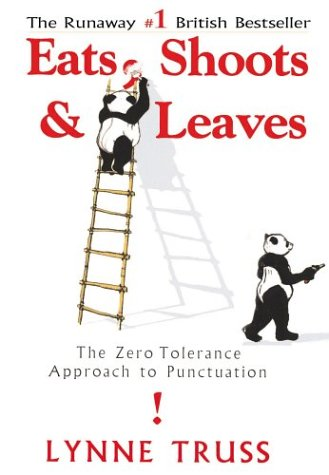
Eats, Shoots & Leaves by Lynne Truss

Eats, Shoots & Leaves
by Lynne Truss
New York, NY:
Gotham Books, 2003.

Achieving what some would call the impossible, Lynne Truss actually makes punctuation interesting. From the six common rules of the comma (plus one not so common) to the history of the semicolon, Truss thoroughly enwraps her readers in a diatribe on the uses and abuses of modern grammatical markings. At her wittiest, she lashes out at grocers and their misuse of apostrophes in plural words (i.e. “Banana’s on sale!”) and the movie business for leaving out the same mark in titles like Two Weeks Notice. At her most informative, Truss identifies the most eloquent moments and horrific mistakes made by authors, journalists, advertisers, and politicians. As commentary and instruction, it is a great read both for those that have ever been a grammatical “stickler” and others that just want a few pointers on how to correctly use an ellipsis. For weeks after reading it, you’ll find yourself questioning every comma you use, and wondering whether Lynne Truss would approve.

Sunday, June 18, 2006

Understanding Comics by Scott McCloud

McCloud, Scott.
Understanding Comics: The Invisible Art
.
HarperCollins Publishers, Inc.:
New York City, 1993.

Creating a work that will be loved by those who already hold comics in high esteem and understood and enjoyed by readers that have never seen anything but the Sunday strips, Scott McCloud’s Understanding Comics: The Invisible Art is an introduction to a medium that is seldom given its due credit. By using a graphic presentation to familiarize the reader with the intricacies of comics, McCloud takes his readers on an in-depth trip through his “comprehensive theory of the creative process.” Using examples from across history and from a wide spectrum of artists that came before him, McCloud discusses the use of line and color, words and vocabulary, the relationship of time and space, symbols and shapes, and the endless possibilities that arise from pen and paper.

At first glance, Understanding Comics is deceptively simple. However, its content covers a wide range of topics in terminology most will easily comprehend and enjoy. McCloud’s talent as both storyteller and artist are evident in this non-fiction work. The theories explained are picked apart in the most adept way, helping the reading along with examples and recurring themes for an overall grasp of topics as part of the whole. While sometimes getting a little wordy for the casual comics reader, an enthusiast will appreciate the explanations of the more subtle nuances that make comics an art form all its own. Though some younger children (5th grade and below) may not be able to grasp all the concepts discussed, the book will be appreciated by anyone of any age that has an interest in this varied art form.

This review was originally written as coursework for a class on Young Adult literature.