Showing posts with label fiction. Show all posts

Monday, May 21, 2007

Amish Paradise

Plain Truth
By Jodi Piccoult
Pocket Books, 1999.

Early one morning, a peaceful Amish farmer finds a dead newborn infant hidden in his barn. Immediately, the once serene property is swarming with police and reporters who quickly suspect the farmer's eighteen year-old daughter of giving birth and killing her own child. Despite the obvious medical evidence against her, Katie stubbornly denies that she was even pregnant let alone able to kill a child. Enter Elli; a distant relative of Katie's who also happens to be an extremely successful attorney from Philadelphia. Ellie quickly moves into Katie's family's home and works to solve the case and clear her client's name. While immersing herself in a culture completely foreign to her, Ellie manages to connect not only with a simpler way of living but also with herself and her past. Ellie and Katie form a close relationship where each woman is helping the other through troubles in their personal lives while fighting towards the common goal of proving Katie's innocence. Both learn a great deal about themselves through their relationship with each other.

I read Plain Truth for my library book club. It grabbed my attention immediately and I had difficulty putting it down when my lunch break ended. The story moves very quickly from the discovery of the body to Katie's hearing and through all of Ellie's research to the dynamic trial and twist ending. It is very interesting to read about the Pennsylvania Dutch and their way of life. I know the author did some very thorough research when writing this novel and I really think (though, my knowledge of the Amish is pretty limited) that she did a great job of portraying their way of thinking and how their views really affected Katie and how she handled her situation. The constant conflicts between Katie and Ellie's feelings about how they should proceed with the trial and life in general are very abundant, almost to the point where it seems a bit repetitive. It seems like every chapter begins with one of the girls deeply hurting the other through misunderstanding and ends with the resolution to their conflict and the conclusion that they are two completely different people. But for the most part its a pretty interesting story that sheds some light on a culture that I, myself am not too familiar with.

Among the people who read this with me, I'd say that it was pretty split as far as how people felt about the ending. Some people thought it was a great way to tie everything up and others were a bit disappointed. I am in the second group. I felt that, even though there was a twist, it was somewhat too late in the story, and I felt that it wasn't as exciting as the rest of the novel had built it up to be. But you'll have to decide that for yourself.

Saturday, April 14, 2007

Punk Love

Nick and Norah's Infinite Playlist
by Rachel Cohn and David Levithan
New York: Alfred A. Knopf, 2006.

It's not necessary for you to care about punk music or identify with teen logic in order to enjoy this book (granted, being familiar with either may make the book more lovable, but they're not required). Nick and Norah's story is one of insane and lusty passion that only 18 year-olds can muster. Their story begins at one of Nick's shows (he's a bassist and master lyricist before even getting to college) and schleps the reader around Manhattan and New Jersey for a packed evening of worrying giddiness, spontaneous frivolity, life-altering decisions, ex-SO encounters, and music only the truly dedicated punk could appreciate. One should note, though, that knowing the music doesn't matter, as the description and emotion behind it is so well transferred to the reader that my great grandmother could get behind its meaning. Playing on all the emotions that plague unsure teenagers that flit from knowing everything to not understanding anything, the tale is a cross-section of life on the verge of independence.

Rachel Cohn and David Levithan (Cohn writing to voice Norah and Levithan writing for Nick) have crafted a story that weaves the lives of young adults perfectly with what is an insane passion for many of the emotional rollercoaster bunch. If you aren't living it in this very moment, anyone can recall the time in which music said everything you wanted it to and the mixed CD (or tape or iTunes playlist as the case may be) was the ultimate expression of emotion. In changing back and forth between the first person views of Nick and Norah, the reader gets both sides of the story, and really gets a glimpse at the warped ways in which two people can view the exact same event. Fun and entertaining from so many perspectives, the authors manage to throw a little psychological game into their writing style. All in all, the book is a raucous and honest (and thoroughly entertaining) display on adolescent love and its constant fluctuation (and, of course, there's some healthy angst thrown in there too).

Friday, March 16, 2007

The Memory of Running

The Memory of Running
By Ron McLarty

Smithy Ide, overweight, middle-aged and bordering on alcoholism lives his life from day to day in a dead end job. While coping with a sudden family tragedy, Smithy uncovers his beloved childhood bicycle and finds himself embarking on a "quest" riding across the country from New Jersey to California. Along the way, he meets many different people who help him deal with issues from his past and guide him towards a new outlook for his future.

From the beginning, it is very easy to root for Smithy. You learn about his tragedies through the setup of the book which tidily alternates between his ride across America and his journey through adolescence. The story is dark, initially involving a lot of sadness and regret, but because of Smithy's wonderful personality and outlook, you end up feeling hopeful and content. I'd say that overall this book is a pretty fast and easy read. The descriptions of the landscape are picturesque but not overly wordy and the characters are all lovable in their own way. It was a good way to split up the multiple nonfiction books I find myself reading these days.

P.S. Look out for Smithy's stop in Mascoutah, Illinois. My hometown. YIPPEE!!!

Wednesday, August 23, 2006

Plainsong by Kent Haruf - because everyone likes a minimalist (in literature, anyway)

Haruf, Kent.
Plainsong.
New York:
A.A. Knopf, 1999.

For anyone who has ever wanted to experience the feel of smalltown life (in a non-anticy way) this is probably a book you should read. In Kent Haruf's Plainsong, non-urban life is depicted through the eyes, experiences, and interactions of a handful of residents of the community of Holt, Colorado. The novel intertwines the lives of a diverse range of characters: from Gunthrie, the newly divorced high school teacher, to his two young sons to a old pair of bachelor ranchers to the pregnant teenager they reluctantly take in. The story that emerges from these intertwining lives never tries to moralize or create a false reality. Rather it paints a moving picture of smalltown life.

This piece of fiction can only be described as minimalistic. The story is not seen from the front, but rather in glances and peripherally. The story never hits you over the head with the chance meetings and communications of the characters. Rather, the story develops naturally, without an omniscient presence guiding the action. It never lacks passion. It never lacks depth. But it does lack a lot of irrelevant prose and details that would destroy the narration. Haruf's tale is one that doesn't hold you on the edge of your seat, but it will keep you engaged until the very end. And really, what more do you want from a minimalist?

Monday, July 31, 2006

Totally Joe by James Howe.


Howe, James.
Totally Joe.
New York:
Simon & Schuster, 2005.


Joe Bunch, an anything-but-average thirteen year-old, is completing an alphabiography for his seventh grade English teacher. It would be a chore for anyone that doesn’t like to talk or tell stories as much as Joe does. However, for this energetic teenager, it is an opportunity to explain his life, friends, crushes, glamour moments, and insecurities on his own terms. From learning how exactly he’s supposed to hang out with his first boyfriend (Um, awkward. Hello.) to the last time he lets himself be taunted by the likes of the school bully (like, don’t even try), Joe tells his own story of realizing who he is and what he wants out of his time in middle school. Covering his life from A to Z, Joe finds out that his friends aren’t perfect, his parents will love him no matter what, and rumors can hurt, but they don’t kill.

James Howe successfully bridges the gap between his own mind and that of a seventh grade boy that believes he’s destined for pop culture stardom. Howe creates Joe’s character embracing the stereotypes of the teenager it seems everyone knows is gay. Joe is that one kid in every middle school that is labeled “flamer”, “queer”, and “fag”. This time, though, instead of running away from it and trying to cover it up, we read about a kid that accepts himself for who he is, knowing that it’s pointless to try and be anything else. Though at times Joe’s life seems a little too blessed and picturesque, one almost wonders if that’s the case, or it’s the positive spin he seems capable of applying in almost any of life’s situations. Accurately depicting some of the many trials adolescents go through in discovering who they are, the reader identifies often with Joe and the self-invoked life lessons he learns, including some philosophical realizations (i.e. “Popularity is a win-win for the popular kids and a lose-lose for everybody else”) and other more obvious ones (such as, “Jack Nicholson is weird”).

On a much more personal note, this book spoke absolute volumes to me. Having grown up in the closet feeling I had to hide who I was, Totally Joe was made real to me in a way it might not come to life for others. At 25 years, I couldn’t be much more out and comfortable with my sexuality. Amazingly, there was still a lot I felt I learned from a 13 year-old that doesn’t even really want to kiss boys yet. While reading, there were many times I wished I could have been the teenager that Joe allows himself to be, but we aren’t all meant to overcome our obstacles with such dramatic poignancy for others to read. For anyone that has a teenager who may or may not be gay (really, people of all types and ages will learn a little from this story) in their classroom, home, or library – this is the perfect book to recommend to them (or just leave it around hoping they might pick it up) and let them find out that it’s okay to be exactly who you are.

Sunday, July 09, 2006

The New Adventures of Abraham Lincoln by Scott McCloud

McCloud, Scott.
The New Adventures of Abraham Lincoln.
La Jolla, California:
Homage Comics, 1998.

What would happen if an assassinated President returned from the dead? What if he tried to reclaim the presidency? What if he wasn’t really the President at all? Scott McCloud ponders such questions in the New Adventures of Abraham Lincoln. While reading about in detention (which he has been sent to for having original thoughts about the Civil War), Byron’s world is thrown a little off when Honest Abe shows up and proceeds to expel his own version of history, one in which fiction is a little more prevalent than fact. After thoroughly confusing the members of detention, Lincoln whisks off to retake Washington in a storm of power and manipulation. It doesn’t sound right to Byron and his friends either, and they quickly set out to discover what’s amiss, and stop America from being overtaken by what is surely an impostor.

Less history lesson or biography and more commentary on modern American complacency and gullibility, McCloud’s adventures are an exercise in how Americans see their past and a new technique (for McCloud) in how to draw graphic comics. The entire novel is done on the computer, giving a different look and feel than McCloud’s previous works. Because it’s a mix of comic characters set against more realistic backgrounds, the reader’s ability to become a part of the comic is fragmented. Because the characters and the setting no longer seem cohesive, the reader is less likely to feel a part of the work, having lost a sense of a possible reality. Though ultimately not very educational or entertaining, the book is still fun and a quick read. A little insight is gained about who Lincoln might have really been and that history is not always the picturesque past we learn about in our grade school classrooms.

Saturday, July 01, 2006

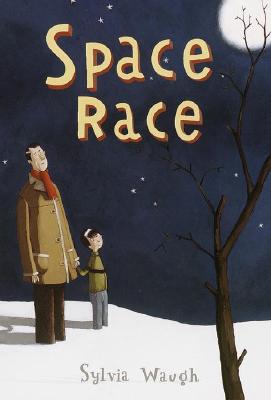
Space Race by Sylvia Waugh

Waugh, Sylvia.
Space Race.
Random House, Inc.:
New York, 2000.

Patrick and Thomas Derwent couldn’t be more average as a British father and son family. They are as plain as can be, except that they came to Earth five years ago in a spaceship the size of a golf ball. Thomas is eleven years-old and has been observing his schoolmate chums everyday, writing down their lives and experiences in journals to document them for his home planet Ormingat. Now their stay as Earthlings is coming to an end and Thomas and his father must make the three year journey home. But as they make their trip back to the spacecraft, an accident separates the two. As the deadline for mandatory takeoff approaches both father and son struggle with what might happen if either are forced to stay in permanent residence in a foreign land without the other.

As such a young child, we see Thomas struggle with his identity as a human on Earth, which is most of what he really understands, and as an alien that remembers little about his home planet. Waugh writes two great characters to the page, hashing out the difficulties of change and understanding yourself and your relationship to those around you. Bringing the emotions to the front through great action, one can’t but wonder what will happen next and who might be coming to whose rescue. Relaying a science-fiction story that seems completely logical, the story comes to life in way that makes you feel it couldn’t possibly be fiction.

This review was originally written as coursework for a class on Young Adult literature.

Tuesday, June 27, 2006

Geography Club by Brent Hartinger

Hartinger, Brent.
Geography Club
.
HarperCollins:
New York, 2003.

Russell operates under the belief that he is the only gay teenager at his entire high school. Until he finds out in an online chat room that one of the best looking jocks on the baseball team is too. Then, he learns that his best friend is bisexual and dating a soccer team lesbian who’s friends with the gay liberal activist. Bonding around their feelings of emotional rejection from their “normal” peers, they form the Geography Club, because no one else will join such a nerdy school group and that way, they don’t have to call it the Gay/Straight Alliance, outing themselves to the rest of the school. But just when things get comfortable, someone really does what to have fun with geography and rumors start flying about which boys like other boys and which players are batting for the “other team.”

Though Hartinger’s story plays hardball with social rejection and the emotional turmoil of adolescent sexuality, it feels like a “When are they gonna kiss already?” saga from the beginning. The sarcastic wit of the first person narrative makes the difficult subject matter easy to read and enjoyable, but the teenage logic follows a stereotypically predictable pattern. The average kid goes for the jock that rejects the nerd that yearns to sit with the popular kids that bully the loser that somehow saves the day. However, even with its formulaic plot, it’s a welcome addition to a common set of themes, but with a healthy gay twist. A great young adult read about how “normal” a gay teenager can be.

This review was originally written as coursework for a class on Young Adult literature.

Monday, June 26, 2006

Ranger’s Apprentice: Book One: The Ruins of Gorlan by John Flanagan

Flanagan, John.
Ranger’s Apprentice: Book One: The Ruins of Gorlan.
Philomel Books:
New York City, 2005.

Fifteen year-old orphan Will has hopes of becoming a knight. Instead, however, he is assigned by the Baron to become an apprentice to a Ranger named Halt, one member of a mysterious corps that protects the kingdom from danger. Though local superstitions of the rangers’ craft leave Will reluctant to join this secretive militia, this first in a fantastical series of books follows the exciting journey of an ambitious young man learning the skills of a cunning and stealthy group of resourceful soldiers. As former enemies of the kingdom begin to cross back into its borders, Will must summon his courage to use his newly learned skills and save his village and the kingdom from harm. These perils are just a glimpse of the dangers soon to come as the series progresses.

Less about its fantastical elements and more about the characters, Will and his friends are brought into stark reality with vivid descriptions of their daily lives. Without losing momentum in the story, the reader learns as Will learns, getting to know more about him, his friends, and the world in which they live. Though each young character seems to learn and grow in maturity, there is a strange lesson about bullying in which the victim is allowed to seek a rather graphic revenge on his tormentors. It doesn’t exactly fit with the element of forgiveness propagated elsewhere in the book. The reader is brought into the ups and downs of their daily lives, as they overcome the difficulties of learning new skills. Excitement and anxiety about what lies ahead for Will are often present and bring the reader into the book’s atmosphere.

This review was originally written as coursework for a class on Young Adult literature.