Wednesday, March 21, 2007

Happy Cruelty Day!: Daily Celebrations of Quiet Desperation

By Bob Powers
Thomas Dunne Books
2006

Sometimes, we need things to celebrate. Sometimes, we need things to do. Sometimes, we need a specific day to lie to our cats about the crucifixion of Jesus (it's February 15th, just in case you were curious). For all of these things, I highly recommend this book.

The genre of books that also serve as a calendar of sorts is in no way a new entrant into the market. Most are flowery and inspirational. Some are funny...sort of. Happy Cruelty Day! is something completely different. Its more a collection of bizarre, completely twisted stories than a calendar telling you how you should spend your day. Sure, everyone will want to participate in "Backrub Train Day" (October 4th) or "Outlet Shopping Day" (March 15th) or even "Be a Hero Day" (September 22), but who really wants to participate in "The Girl of Your Dreams has been Kidnapped Day" (July 14th) or "Indadvertantly Steal from a Drug Kingpin Day" (March 5)? You may not want to do these things, but reading about them is a great way to pass some time. The stories are well written and creative to the point of absurd, but it will definitely serve to put a smile (or possibly a grimace) on your face if you are having a bad day.

Friday, March 16, 2007

The Memory of Running

The Memory of Running
By Ron McLarty

Smithy Ide, overweight, middle-aged and bordering on alcoholism lives his life from day to day in a dead end job. While coping with a sudden family tragedy, Smithy uncovers his beloved childhood bicycle and finds himself embarking on a "quest" riding across the country from New Jersey to California. Along the way, he meets many different people who help him deal with issues from his past and guide him towards a new outlook for his future.

From the beginning, it is very easy to root for Smithy. You learn about his tragedies through the setup of the book which tidily alternates between his ride across America and his journey through adolescence. The story is dark, initially involving a lot of sadness and regret, but because of Smithy's wonderful personality and outlook, you end up feeling hopeful and content. I'd say that overall this book is a pretty fast and easy read. The descriptions of the landscape are picturesque but not overly wordy and the characters are all lovable in their own way. It was a good way to split up the multiple nonfiction books I find myself reading these days.

P.S. Look out for Smithy's stop in Mascoutah, Illinois. My hometown. YIPPEE!!!

Monday, March 12, 2007

Reviewers do it with commentary.

I was looking back at the archives of our fine blog and I realized something didn't make sense. The blog was originally meant to be written by one person (that'd be me, MuzikMakers). There are now three people writing reviews. Basically, the first couple of entries don't clue anyone into that and so I thought I'd let everyone know what the big to do is.

SoothSays116 has been around for a little while now and has made some contributions. I did not give her a proper introduction, but I don't know that she'd want one (she tends to keep her Internet life rather anonymous). Being just as busy as I am, she hasn't had the chance to post much, but we love her contributions of wit and wisdom when she has the time.

I am proud to now announce that GypsyRose will be joining us as well. She has decided to make her first attempt at writing some bookish stuff and we are pleased to have her. She's an avid reader and will surely add to the overall reading pleasure of us all. Her first review will appear soon. Thanks for reading our blog and thanks for the comments. Enjoy!

Wednesday, January 10, 2007

Everything (Randy Shilts thinks) you need to know about the history of AIDS from 1980-1985.

And the Band Played On
By Randy Shilts
1987
St. Martin's Press

Documenting the beginning of the AIDS epidemic, Randy Shilts’ And the Band Played On is an extensive collection of personal accounts, scientific reports, community history, and political movements. Shilts was a journalist in San Francisco when the AIDS epidemic began and used much of his research for the San Francisco Chronicle for the material of this book. Weaving the personal emotions of gay and lesbian activists with the hard-nosed facts of scientists (which so often seem to be tainted by personal agendas and ambitions), this work of nonfiction is a startling revelation of the individual struggles, group clashes, government bungling, and management disasters of possibly the most disastrous health crisis in American history.

Though effective and convincing, Shilts’ work is incredibly long. Detailing the lives and events of many individuals, Shilts makes many of the same points over and over again. Perhaps he goes to such great lengths because the AIDS epidemic was ignored by so many government officials and members of society for so long, but at 600 pages plus, it is an extensive work that is difficult to trudge through at times. On the other hand, in hundreds of interviews and through research with many groups, Shilts reveals a nearly comprehensive story of how the AIDS virus came to be discovered and the horrible ways in which its most vulnerable victims were marginalized by the Regean administration, funding for research was withheld, and the suffering and indignity that accompanied such a massive loss of life across the globe.

Sunday, October 22, 2006

Have you ever felt bad and decided that what you really wanted was to feel worse?

You Are Worthless: Depressing Nuggets of Wisdom Sure to Ruin Your Day.
by Scott Dikkers & Oswald T. Pratt
1999
Andrews McMeel

Have you ever woken up and thought "I feel bad about my life, but I'm just not sure I feel bad enough." Then this is the book for you. You Are Worthless is the anti self-esteem book. It is the book that isn't afraid to say that not only is the glass not half full, but that the half empty glass that you are left with consists of arsenic and cat pee.

Written in the form of a "inspiring quotes" book, Dikkers and Pratt create a set of hilarious, if not blatantly offensive, quotes designed to showcase that life is not sunshine and rainbows. Religion, Love, Kids, Pets, Work - all topics covered with cynical delight. Ever thought that love sucks? Well, that's probably because you are a loser. Think your pets like you? Try not feeding them for a few days and see what happens. Feel safe flying in a plane? Well, think pleasant thoughts about underpaid airplane mechanics and then see how safe you feel.

This book is not meant to help the seriously depressed, but rather meant to give a laugh to anyone who is willing to believe that life is not meant to be cookies and puppies. This book is an absolute delight and a must read for anyone with a slightly darker sense of humor who is not afraid to admit that sometimes, life just sucks...and that's okay.

Sunday, September 17, 2006

The Little Book that Beats the Market by Joel Greenblatt

The Little Book that Beats the Market
By Joel Greenblatt
Hoboken, NJ:
John Wiley & Sons, Inc., 2006.

If you're an individual investor without a lot of Wall Street know-how, you need to get this book. Whether you've just started your IRA, recently received an inheritance, or have been sitting on a piggy bank worth a few too many grand (buy a money market fund already), you need to read this book. Even if you don't have any money yet or don't really have a whole lot of interest in investing, read the book anyway (it's worth the few short hours it will take to get through it). Many have already said that this is the "investor's book of the year," so I don't need to repeat it. They're not lying, and this may be the only investment strategy you'll ever need. Unless, of course, you're a lot smarter than everyone else and have an inordinate amount of time to spend researching securities like a professional and understand a market that I'm not sure anyone fully comprehends. But, I digress.

Joel Greenblatt, with a touch of both sarcasm and sincerity, has created a magic formula for buying stocks. Yes, he even calls it a magic formula. That is how beautiful (and simple) it is. If you're not immediately skeptical, you should be, because anyone that's ever looked into investing knows there's no such thing as a magic formula. That being said, if you're not convinced by the end of the book that Greenblatt's formula does work, than you have a higher level of skepticism (and a stronger will against persuasion) than I. The formula revolves around two general rules: buy stock from good companies and buy it at bargain prices. There's some mumbo jumbo about yield, return, and capital in there, but those are his main points. It is probably the most logical thing I've ever heard in investing. Greenblatt explains his formula thoroughly and in a way that an 11 year-old can understand. He even writes with some humor and without being condescending, which is an accomplishment considering he's done well enough to boast a little if he wanted to. At the end of his book, he lays out a step-by-step plan that is nearly foolproof. To go further, he has created a Web site that even helps you pick the stocks. And get this, the Web site (for now at least) is free. If you want to play the market but you don't know and don't want to lose a lot of money learning, this is the book for you.

Tuesday, August 29, 2006

Eats, Shoots & Leaves by Lynne Truss

Eats, Shoots & Leaves
by Lynne Truss
New York, NY:
Gotham Books, 2003.

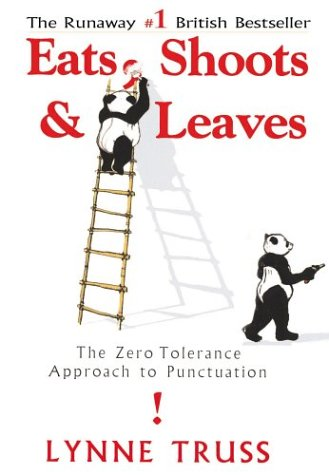
Achieving what some would call the impossible, Lynne Truss actually makes punctuation interesting. From the six common rules of the comma (plus one not so common) to the history of the semicolon, Truss thoroughly enwraps her readers in a diatribe on the uses and abuses of modern grammatical markings. At her wittiest, she lashes out at grocers and their misuse of apostrophes in plural words (i.e. “Banana’s on sale!”) and the movie business for leaving out the same mark in titles like Two Weeks Notice. At her most informative, Truss identifies the most eloquent moments and horrific mistakes made by authors, journalists, advertisers, and politicians. As commentary and instruction, it is a great read both for those that have ever been a grammatical “stickler” and others that just want a few pointers on how to correctly use an ellipsis. For weeks after reading it, you’ll find yourself questioning every comma you use, and wondering whether Lynne Truss would approve.

Wednesday, August 23, 2006

Plainsong by Kent Haruf - because everyone likes a minimalist (in literature, anyway)

Haruf, Kent.
Plainsong.
New York:
A.A. Knopf, 1999.

For anyone who has ever wanted to experience the feel of smalltown life (in a non-anticy way) this is probably a book you should read. In Kent Haruf's Plainsong, non-urban life is depicted through the eyes, experiences, and interactions of a handful of residents of the community of Holt, Colorado. The novel intertwines the lives of a diverse range of characters: from Gunthrie, the newly divorced high school teacher, to his two young sons to a old pair of bachelor ranchers to the pregnant teenager they reluctantly take in. The story that emerges from these intertwining lives never tries to moralize or create a false reality. Rather it paints a moving picture of smalltown life.

This piece of fiction can only be described as minimalistic. The story is not seen from the front, but rather in glances and peripherally. The story never hits you over the head with the chance meetings and communications of the characters. Rather, the story develops naturally, without an omniscient presence guiding the action. It never lacks passion. It never lacks depth. But it does lack a lot of irrelevant prose and details that would destroy the narration. Haruf's tale is one that doesn't hold you on the edge of your seat, but it will keep you engaged until the very end. And really, what more do you want from a minimalist?

Friday, August 11, 2006

Maybe it fits my multiple personalities.

I'm still reading Eugenides' Middlesex. For some reason, my reading is slow, but the book is enthralling. There are three plot lines weaving throughout the narration. The protagonist is telling the story of his grandparents while simultaneously talking about his own past and present. I am amazed at how quickly the narration jumps from one time period to the next, but I'm even more shocked at how easy it is to follow.

These types of changes - the going back and forth between stories with barely a pause - they are the bees knees for me (that's right, the bees knees). One of my most treasured experiences in reading is during Aldous Huxley's Brave New World. In Chapter 3, there are three different scenes taking place, one after the other. At first, each goes on for pages. Gradually, they begin to intertwine, and take up only paragraphs, but are still separated. As each scene only gets sentences, they begin to crash into one another, follow each other, and push to keep attention. It's absolutely gorgeous. I think I read it three or four times before I could move on to the next chapter.

Though in a completely different pattern and presentation, Middlesex is kind of like that. One story is prominent right now, but every once in a while, another will cross and step in, even if for just a moment. I don't know whether they'll crash or simply begin flowing into one another, eventually allowing another plot line to overcome as the story progresses, but it's thrilling to watch them roll back and forth. The reading is seamless, but the moments are all over the place. I'm in love.

Monday, July 31, 2006

Totally Joe by James Howe.


Howe, James.
Totally Joe.
New York:
Simon & Schuster, 2005.


Joe Bunch, an anything-but-average thirteen year-old, is completing an alphabiography for his seventh grade English teacher. It would be a chore for anyone that doesn’t like to talk or tell stories as much as Joe does. However, for this energetic teenager, it is an opportunity to explain his life, friends, crushes, glamour moments, and insecurities on his own terms. From learning how exactly he’s supposed to hang out with his first boyfriend (Um, awkward. Hello.) to the last time he lets himself be taunted by the likes of the school bully (like, don’t even try), Joe tells his own story of realizing who he is and what he wants out of his time in middle school. Covering his life from A to Z, Joe finds out that his friends aren’t perfect, his parents will love him no matter what, and rumors can hurt, but they don’t kill.

James Howe successfully bridges the gap between his own mind and that of a seventh grade boy that believes he’s destined for pop culture stardom. Howe creates Joe’s character embracing the stereotypes of the teenager it seems everyone knows is gay. Joe is that one kid in every middle school that is labeled “flamer”, “queer”, and “fag”. This time, though, instead of running away from it and trying to cover it up, we read about a kid that accepts himself for who he is, knowing that it’s pointless to try and be anything else. Though at times Joe’s life seems a little too blessed and picturesque, one almost wonders if that’s the case, or it’s the positive spin he seems capable of applying in almost any of life’s situations. Accurately depicting some of the many trials adolescents go through in discovering who they are, the reader identifies often with Joe and the self-invoked life lessons he learns, including some philosophical realizations (i.e. “Popularity is a win-win for the popular kids and a lose-lose for everybody else”) and other more obvious ones (such as, “Jack Nicholson is weird”).

On a much more personal note, this book spoke absolute volumes to me. Having grown up in the closet feeling I had to hide who I was, Totally Joe was made real to me in a way it might not come to life for others. At 25 years, I couldn’t be much more out and comfortable with my sexuality. Amazingly, there was still a lot I felt I learned from a 13 year-old that doesn’t even really want to kiss boys yet. While reading, there were many times I wished I could have been the teenager that Joe allows himself to be, but we aren’t all meant to overcome our obstacles with such dramatic poignancy for others to read. For anyone that has a teenager who may or may not be gay (really, people of all types and ages will learn a little from this story) in their classroom, home, or library – this is the perfect book to recommend to them (or just leave it around hoping they might pick it up) and let them find out that it’s okay to be exactly who you are.

Thursday, July 27, 2006

A hiatus efficiently broken.

The class that I was taking ended. As you can imagine, with all the reading that had to be completed in such a short period of time, I had to take a little break. I had all these graphic novels and young adult books sitting around that I wanted to read, but I couldn't bring myself to pick any of them up. It was just too much kid lit at once. On my way to the airport for a trip back home after some time away from reading, I decided it was time to discontinue both my time off from literary adventures and the streak I've had with young adult stuff, and I'm doing it with a bang.

A friend recommended Middlesex to me; though, I have to admit that I've been eyeing it for some time. The cover and title of Jeffrey Eugenides' book are both intriguing and mysteriously alarming; I was intrigued. As I boarded the plane for my journey, I was exhausted and was thinking about just sleeping for most of the flight, but as the plane took off, I cracked the spine anyway. The first paragraph cued me into the fact that it was time to nap because the reading was going to be heavy, but also that this was going to be an incredible book. Though sleepiness forced the book closed at the time, I've never been so drawn in by the opening of a novel. I think you'll understand what I mean:

I was born twice: first, as a baby girl, on a remarkably smogless Detroit day in January 1960; and then again, as a teenage boy, in an emergency room near Petoskey, Michigan, in August 1974. Specialized readers may have come across me in Dr. Peter Luce's study, "Gender Identity in 5-Alpha-Reductase Psuedo- hermaphrodites," published in the Journal of Pediatric Endocrinology in 1975. Or maybe you've seen my photograph in chapter sixteen of the now sadly outdated Genetics and Heredity. That's me on page 578, standing naked beside a height chart with a black box covering my eyes.
How could I not feel suddenly sucked into that world and want to know more. In one short paragraph is a history, with holes begging to be filled. After so much lighter fare, this might take me a little longer to read, but I have a feeling I'll enjoy it immensely.

Monday, July 10, 2006

King: A Comic Biography of Martin Luther King, Jr. by Ho Che Anderson

Anderson, Ho Che.
King: A Comics Biography of Martin Luther King, Jr
.
Seattle, WA:
Fantagraphics Books, 2005.


In Stanley Crouch’s introduction to this biography, he puts Anderson’s work into perspective. In this book, we are given “a mix of fact and fiction, an interpretation for the purposes of entertainment, and a jumbling of imagined conversations and relationships that puts it as much in the realm of fiction as biography.” It is important to remember this statement throughout reading this provocative graphic novel. Following King from meeting Coretta Scott during his graduate studies through the bus boycotts, the freedom rides, the march on Washington and many other events in between, Anderson’s biography is a startling work of artistry, history, and creative license in non-fiction. Piecing together possible moments of the man’s personal life and public moments of the “humble” reverend in marches and speeches, Anderson brings a certain humanity to a historical figure that has gone beyond legendary status. Like suddenly discovering the Gnostic Gospels when all there’s ever been is Matthew, Mark, Luke and John, Anderson’s King is a man few would readily recognize, for the figure we often see today is stripped of his personality flaws and character blemishes.

The biography was created in a style reminiscent of film noir. With deep shadows and figures only half-seen, the entire work resonates with the harsh realities of segregation and the unevenly distributed rights of American citizens based on their race. Most of the biography is limited to black and white drawings, but Anderson applies color in the most dramatic moments and to represent the more significant symbols of the Civil Rights Movement. However, as stunning as the images may be, Anderson’s sometimes abstract style requires careful reading, for the flow of the story can be lost as the author jumps between settings and time periods. When presented as an alternative view to history textbooks, this work is ideal for the younger reader, bringing the reality of history closer and telling a whole story, as opposed to just the glorified moments of fame and melodrama. However, it is important to inform readers that much of this work is not based on identifiable facts, but one author’s interpretation of historical events. Neither complete fact nor wholly fiction, Anderson’s work brings new light and darkness to a man of great strength that moved many into a nonviolent revolution.

9-11: Emergency Relief

9-11: Emergency Relief.
Gainesville, Florida:
Alternative Comics, 2002.


In a compilation of works by over 60 artists, 9-11: Emergency Relief is part memoir, biography, and tribute. With all proceeds being donated to the American Red Cross, it is an astonishing work of both philanthropy and comics. There are some well-known contributors such as Jessica Abel, Will Eisner, Peter Kuper, Harvey Pekar, and Ted Rall. Others are just making their way into the comics arena and their stories are no less moving. Most of the contributions tell the story of what happened to each particular artist on September 11, 2001. More than a few were completed within less than a week of the terrorists’ attacks, provoking a raw telling of the events in each author’s personal view. Rarely engaging humor in their work, many stories invoke the same emotions so many citizens experienced in the days after that terrifying tragedy.

In the creation of comics instead of essays, the book displays an array of emotions in visual detail, as opposed to a cognitive representation of written language. If one can set aside their feelings (a difficult task in such a moving collection) and simply take in the different pieces, the book as a whole is a stunning anthology of the many different styles used throughout the graphic form. Ranging from the harshly abstract to the cartoonish, the reader gets a sense of the limitless possibilities offered to comics’ artists. For the many young adults unfamiliar with graphic novels, this work, though heavy with emotion, is an excellent introduction to the many artists currently working in the field. Giving the reader a chance to learn more about the artists they most enjoy, at the end of the book is a bio of each contributor, often detailing the other works and projects of their careers.

Sunday, July 09, 2006

The New Adventures of Abraham Lincoln by Scott McCloud

McCloud, Scott.
The New Adventures of Abraham Lincoln.
La Jolla, California:
Homage Comics, 1998.

What would happen if an assassinated President returned from the dead? What if he tried to reclaim the presidency? What if he wasn’t really the President at all? Scott McCloud ponders such questions in the New Adventures of Abraham Lincoln. While reading about in detention (which he has been sent to for having original thoughts about the Civil War), Byron’s world is thrown a little off when Honest Abe shows up and proceeds to expel his own version of history, one in which fiction is a little more prevalent than fact. After thoroughly confusing the members of detention, Lincoln whisks off to retake Washington in a storm of power and manipulation. It doesn’t sound right to Byron and his friends either, and they quickly set out to discover what’s amiss, and stop America from being overtaken by what is surely an impostor.

Less history lesson or biography and more commentary on modern American complacency and gullibility, McCloud’s adventures are an exercise in how Americans see their past and a new technique (for McCloud) in how to draw graphic comics. The entire novel is done on the computer, giving a different look and feel than McCloud’s previous works. Because it’s a mix of comic characters set against more realistic backgrounds, the reader’s ability to become a part of the comic is fragmented. Because the characters and the setting no longer seem cohesive, the reader is less likely to feel a part of the work, having lost a sense of a possible reality. Though ultimately not very educational or entertaining, the book is still fun and a quick read. A little insight is gained about who Lincoln might have really been and that history is not always the picturesque past we learn about in our grade school classrooms.

Pedro and Me by Judd Winick

Winick, Judd.
Pedro & Me: Friendship, Loss, and What I Learned.
New York:
Henry Holt and Company,
New York, 2000.

Moving from the melodrama of MTV’s heavily edited reality show The Real World to a nostalgic and moving graphic memoir is no easy transformation. While millions of television viewers saw Pedro Zamora’s activism about AIDS awareness and later saw him become a victim of the disease, there was an even more personal and real experience going on for Zamora and Winick behind the screen. Though he educated many Americans about the truths of HIV and AIDS, he perhaps taught no one more than Judd Winick. Winick’s memoir about Pedro and their relationship tells the reader what happened before, during, and after the show, going far beyond what most of us saw on screen.

Winick is an excellent storyteller and makes a lasting impression with this artistic graphic work. Not only is the story emotionally moving, but the art is created in such a way that it is a compelling read. Knowing the outcome of Pedro’s life doesn’t make the story any less engaging. Winick manages to draw the reader in with a unique use of panel movement, taking a detour from the standard boxes and creating a dynamic between the characters and their environment that pushes the story onward. Though Pedro’s life story is poignant on its own, Winick’s presentation gives more power and presence in its graphic form than could be achieved otherwise.

Friday, July 07, 2006

Barefoot Jen: Volume One by Keiji Nakazawa

Nakazawa, Keiji.
Barefoot Jen: Volume One: A Cartoon Story of Hiroshima
.
San Francisco:
Last Gasp of San Francisco, 2004.


This first volume of the Barefoot Gen series introduces the Nakaoka family, chronicling their lives in Hiroshima during the ongoing war against the Allied forces. Gen is a six year-old whose father believes Japan’s initial and continued participation in the war is both a mistake and a dishonorable move by Japanese leadership. Year of war having already passed, the Gen’s parents struggle to feed a family of five children. Though it eases the burden on mouths to fill, it is no less of a struggle emotionally when one son is sent into the countryside for safekeeping and the oldest son disobeys his father’s wishes and joins the military, only to later realize that his father’s disgust with the Japanese government is well-placed. All of these events occur around the misadventures of Gen and his little brother Shinji, a rambunctious pair that get into no end of trouble, but usually with the best of intentions. Becoming so familiar with such an emotional family makes the inevitable conclusion all the more horrific as the Enola Gay drops the first atomic bomb on the town and its inhabitants, destroying everything in its path and sending thousands to a painful, torturous death. The volume ends with this destruction, leaving the reader to discover what happens to the family in Volume Two: The Day After.

More fictional memoir than autobiography, Barefoot Gen is loosely based on Nakazawa’s experiences, the boy being referred to as his “alter-ego.” Where other graphic works often use narration to describe emotions and events, Nakazawa uses the manga style to place everything in plain view of the reader through action. Without a narrator, the reader gains a sense they are witnessing the story as it actually happens. Though the manga style can often be presented as more fantasy than reality, Nakazawa uses it as a device to make the situation more real, enhancing events to bring them closer to the reader. Ultimately, Nakazawa presents a case for peace and relates a story that leaves readers hoping such tragedies never happen again.

The Amazing "True" Story of a Teenage Single Mom by Katherine Arnoldi

Arnoldi, Katherine.
The Amazing "True" Story of a Teenage Single Mom.
New York:
HyperionBooks, 1998.


Katherine Arnoldi, a victim of sexual abuse, had a child at age 17. Without support from her family, she struggles to make ends meet, working in a factory and various restaurants. Seeking the chance at a new beginning, she moves out West with her baby and her boyfriend. After arriving in Arizona, her boyfriend turns on her and she becomes entrenched in a physically abusive relationship. Throughout all this, Kathy dreams of going to college and becoming a chemist, a dancer, a teacher, an artist, or all of the above. Fearing for herself and her child, she runs away from her new home, knowing almost no one in an area with which she is unfamiliar. She and her daughter wind up in Denver, living with an old roommate, and she finally gains the support she needs through friends she meets. Slowly, with determination, she is able to overcome the obstacles before her and turn her life around, earn an education, and support herself and her child on her own.

A short autobiographical work, Arnoldi’s story is swift but poignant. Though the difficulties in her life are made clear, the emphasis is placed on being able to overcome them. She makes it understood, however, that a woman doesn’t have to do this on her own. Arnoldi realizes that it takes a certain amount of courage to take the first step in leaving an unhealthy relationship or a troubled life, but she shows that there are so many to get help after that first step is made. Giving examples of who those others might be, Arnoldi lists a few resources in the back of the book that might help a young woman in her same situation.

The illustrations Arnoldi uses vividly show both the frightening and joyful moments throughout her story. Though they have their likeness to a cartoon strip style, she develops each page with small details related to the story but unnecessary to its plot. The result is layers of meaning that go beyond the surface, taking the reader into a closer relationship with the character and her plight. The brevity of the story makes it accessible to many, but most importantly to the young, single mothers that need to read it for its message of determination and personal strength.

Thursday, July 06, 2006

Marx for Beginners by Ruis

Ruis.
Marx for Beginners.
Trans. Richard Appiagnanesi.
New York:
Pantheon Books, 1976.

Functioning as both biography and history book, Marx for Beginners is an introduction to Communism and its most well known philosopher, Karl Marx. Understanding the daunting task before him, Ruis makes an attempt at summarizing, condensing, and explaining the beginnings of Communist philosophy. Beginning with an introduction to Marx, Ruis continues with the background behind its development. As Ruis further explains how Marx came to his revolutionary ideas, there is more explanation of the revolutionary thinker as well. Though certainly not comprehensive in any aspect, Ruis does break down a substantial number of ideas, thoughts, actions, attempting to make them more accessible to the reader.

Though much of the material in Marx for Beginners is helpful and easy to understand, it gets lost somewhere between the words and the graphics Ruis creates. The book is not a history in graphics, but a history with graphics. Much of what the reader learns is presented in a typical text format, though it is in a more comic script. The characters and pictures have little sequential meaning and are typically meant to be humorous sidebars on whatever historical or informational statement the book has made. They often appear more as a distraction to the flow of the work than an addition. While the graphics certainly make the substance lighter, it does not adequately contribute to its accessibility or ultimate understanding. The book remains informative, but little is gained by its presentation in the graphic medium. Had this not been the case, it might have survived as a work worthy of presentation indefinitely as a tool to understand Communism by reluctant readers of history, but since the ending of the Cold War, it is destined to become a relic of “fun” historical works.

Wednesday, July 05, 2006

Persepolis by Marjane Satrapi

Satrapi, Marjane.
Persepolis: The Story of a Childhood.
Pantheon Books:
New York, 2003.

Persepolis is the autobiography of Marjane Satrapi, writing and illustrating in graphic form her life as a girl growing up in Iran during the Islamic Revolution. Satrapi’s memoir begins at age ten in 1980 as the Ayatollah overtakes the Shah of Iran and begins such practices as forcing women to wear veils in public. The reader learns about a girl struggling with the ideas of what her family considers an extremist religion and the imprisonment of her relatives due to their rebellion against the theocracy’s ways. Though not even old enough to have an interest in boys, Marji has enough vigor to want to join her parents at protests. As Satrapi ages in the story and becomes a teenager, her interest in boys increases while her understanding of the revolution and the ensuing war decreases.

Satrapi's work is both humorous and horrifying. Through unadorned black and white comics, she is able to portray the strongest emotions to the reader, allowing them to sympathize with her past. It is perhaps this simplicity that brings the reader to so easily identify with her character, understanding her joy, sadness, and confusion. As an autobiography, it brings to life recent events so often misunderstood by teenagers and adults alike. Though it is definitely slated to her side of the story, it is a side of history most Americans have never heard. This book is a gateway to the realization that these conflicts are not so far away from our own American existence and that they affect people globally. In mixing her daily life with the trials of war, Satrapi brings the events right to our doorstep, never once allowing the reader to think this is happening outside the realm of possibility for anyone, though one may wish that were true. Four years of Satrapi’s life leaves the reader wondering how so much can happen to one person and how so many of us could remain unaware and unconcerned of its occurrence.

Saturday, July 01, 2006

Space Race by Sylvia Waugh

Waugh, Sylvia.
Space Race.
Random House, Inc.:
New York, 2000.

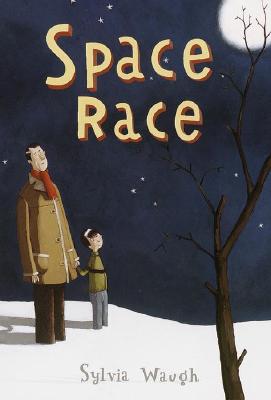
Patrick and Thomas Derwent couldn’t be more average as a British father and son family. They are as plain as can be, except that they came to Earth five years ago in a spaceship the size of a golf ball. Thomas is eleven years-old and has been observing his schoolmate chums everyday, writing down their lives and experiences in journals to document them for his home planet Ormingat. Now their stay as Earthlings is coming to an end and Thomas and his father must make the three year journey home. But as they make their trip back to the spacecraft, an accident separates the two. As the deadline for mandatory takeoff approaches both father and son struggle with what might happen if either are forced to stay in permanent residence in a foreign land without the other.

As such a young child, we see Thomas struggle with his identity as a human on Earth, which is most of what he really understands, and as an alien that remembers little about his home planet. Waugh writes two great characters to the page, hashing out the difficulties of change and understanding yourself and your relationship to those around you. Bringing the emotions to the front through great action, one can’t but wonder what will happen next and who might be coming to whose rescue. Relaying a science-fiction story that seems completely logical, the story comes to life in way that makes you feel it couldn’t possibly be fiction.

This review was originally written as coursework for a class on Young Adult literature.